When fillers entered the market, a paradigm shift in the world of cosmetic aesthetics occurred. Efforts to pull and tighten wrinkles away (often through facelifts and other surgical procedures) gave way to an emphasis on replacing lost volume, a significant cause of the appearance of facial ageing. Today the focus is on replacing lost fat pad volume and restoring the natural contours of the face through the strategic use of fillers.
What are fillers?
Dermal fillers are injectable gels that are used to create a firm and youthful appearance by contouring facial features and minimising deep creases, fine lines and hollowed areas. The biodegradable gel is gradually absorbed by the body and naturally metabolised over time.
Which areas can be treated with fillers?
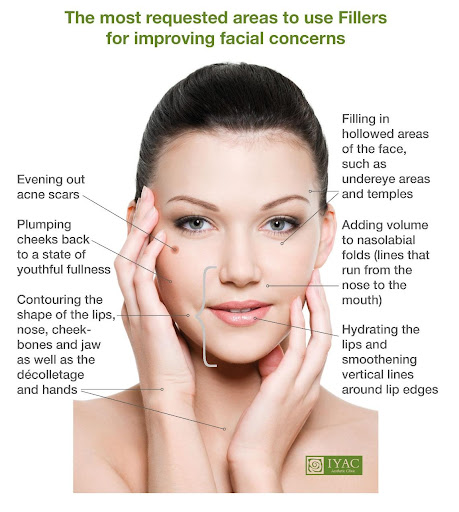
Dermal fillers can be used to improve a variety of facial concerns that relate to ageing, including:
– Adding volume to nasolabial folds (lines that run from the nose to the mouth)
– Restoring the cheeks to a youthful fullness
– Filling in hollowed areas of the face, such as undereye areas and temples
– Hydrating the lips and smoothening vertical lines around lip edges (lipstick lines)
– Contouring the shape of the lips, nose, cheekbones and jaw as well as the décolletage and hands
– Evening out acne scars
What makes people choose fillers?
Fillers are prevalent because they provide gratification without surgery and lengthy healing times. Results are consistent, reproducible and facial expressions are not affected. Most people are able to resume their usual activities on the same or next day. Many fillers also kick-start a process called neocollagenesis, or the creation of new collagen around the injection site, which further slows the ageing process.
How have fillers changed over the years?
When fillers were first introduced to the mass market in the late 1970s, they were made of collagen. Most fillers today are made of different materials, such as:
Hyaluronic acid: a filler made of a lubricating fluid that is naturally found in the skin, eyes, joints and tissues as well as countless beauty products due to its ability to boost hydration, prevent moisture loss, seal in dewiness and plump up the skin. It is also applied on burns and skin wounds, directly injected into arthritic joints and used in moistening eye drops.
Calcium hydroxylapatite: this naturally occurring mineral substance is found in the bones and teeth of the human body. It is used for a number of different medical purposes, including reconstructive surgery, ear-nose-throat (ENT) conditions, maxillofacial surgery, dentistry and urology. Its thick consistency makes it suitable for deep fold filling and facial contouring.
Poly-L-Lactic acid – this biodegradable polymer has a long-standing history of safe use in medical applications, such as pins, plates, screws, intra-bone and soft-tissue implants. It restores lost facial volume by initiating neocollagenesis, whereby the body creates new collagen over time. Eventually the gel is metabolised to carbon dioxide and water and naturally expelled from the body.
What types of fillers do you offer?
IYAC offers a range of fillers with different formulations and capabilities. Read more about which fillers IYAC offers here.
Are fillers safe?
The fillers offered at IYAC have been extensively tested and used safely for many years. They have undergone rigorous clinical testing and have been administered by physicians to hundreds of thousands of patients worldwide.
Are treatments painful?
Besides a small prick, most people find the injections to be relatively painless. Ultrafine needles are used to decrease discomfort. When enhancing the lips, a local anesthetic injection is often administered, similar to being at the dentist.
Will my face look fatter or wider?
This is a common question as fillers are normally used to fill wrinkles and hollows. However, the usage of fillers has evolved over the years beyond the simple treatment of wrinkles.
To get a skin lifting and tightening effect of the facial tissues instead of a plumping effect, the filler is injected into the subdermal (upper) or supraperiosteum (deep) layers instead of the subcutaneous (middle) layer. This works by addressing the negative vectors of ageing (gravitational pulls). Hence, the strategic placement of the filler material in the accurate plane of the skin determines whether you get a lifting or a plumping effect.
Lastly, some celebrities have been known to overdo it with fillers, using them all over the face and in large amounts i.e. “over-filled” face. IYAC is committed to a less-is-more approach through our philosophy of subtle improvements.
What are the side effects?
Side effects can include bruising, redness, swelling, pain, tenderness and itching at the injection sites. Most of these diminish within 48 hours with the exception of mild bruising which may take two to 10 days to gradually fade. Make-up is often sufficient to cover most mild bruising. In rare cases, small lumps may form under the skin near the injection site. However, these are generally treatable and corrective measures can be taken to resolve them. Most patients are able to resume normal activities on the same or next day, although strenuous exercise should be avoided for 48 hours.
I am interested in having filler treatments done. How do I prepare?
At your initial consultation, our doctors will address your specific concerns taking into account the areas being treated, your skin type and budget in order to choose the right filler treatment for you. To minimise bruising, stop blood-thinning supplements and medications five days before your treatment. This includes aspirin, vitamin E, fish oil and gingko. If you have a history of cold sores, please let us know, as medication may be provided to help prevent a recurrence.
You will also be given homeopathic preparations like arnica tablets and arnica gel, along with an LED treatment immediately after your session to support your skin’s natural healing process.
If you are preparing for a special event, we recommend scheduling your treatment three to four weeks in advance, especially if this is your first treatment, to ensure optimal results.
Finally, learn about our filler safety protocols and how to prepare for a smooth and comfortable treatment experience. We are here to guide you every step of the way, ensuring you feel confident and at ease.
If I had a laser treatment or chemical peel recently, can I still get fillers?
It is recommended that you wait until recent cosmetic treatments totally heal, or approximately two to four weeks after your last laser or chemical treatment.
Who should not have filler treatments?
Women who are pregnant should not have fillers. People with bleeding disorders, previous allergic reactions that required hospital treatment, or a history of keloid scarring treatment should also avoid fillers.
Price:
From S$1090 – S$1635 per syringe, depending on the filler.