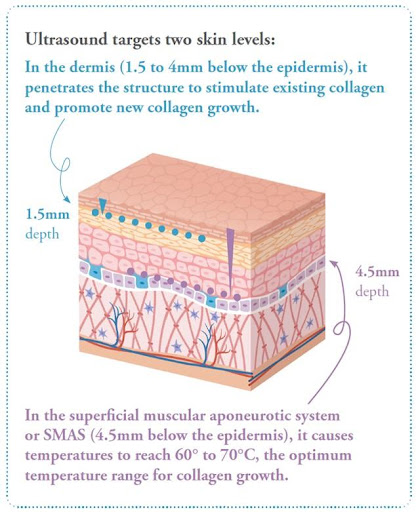
In HIFU, the ultrasound energy stimulates collagen production in the dermis and superficial muscular aponeurotic system (SMAS). The dermis is located beneath the epidermis and is the thickest of the three layers of the skin (1.5 to 4mm thick). It makes up approximately 90% of the thickness of the skin and contains much of the body’s water supply. It is held together by collagen, a tough connective protein that supports the epidermis and provides our skin with strength and resiliency. The SMAS lies under the dermis; it is one continuous fibrous network that connects the dermis to underlying facial muscles. It consists of a three-dimensional scaffold of collagen, elastic and fat.
At a depth of 3mm, the ultrasound penetrates the dermis to reach the skin’s collagen supply. Here, it stimulates existing collagen and promotes the growth of new collagen. This is important because collagen is the supporting structure that anchors cells to one another. Collagen is what gives our skin strength, suppleness and elasticity. As collagen production declines (in our 20s), the skin becomes lax and lines and wrinkles form. This treatment slows that process.
At a depth of 4.5mm, the ultrasound energy reaches the SMAS and heats it to 60° to 70°C, the optimum temperature range for collagen synthesis. This is the same area that plastic surgeons target during surgical facelifts because it provides longer-lasting results than a facelift of the skin alone. As the ultrasound penetrates collagen in the SMAS, it causes a lifting effect of the face and neck.
As a result of the high amount of heat energy, HIFU can also reduce fat under the skin, making it particularly useful for reducing double chins and hanging jowls.
The ultrasound energy penetrates the deep layers of the skin while leaving the epidermis completely unharmed. It works sub-dermally (under the skin) so there is no resulting downtime or disruption to your social schedule.
What areas of the face that can be lifted and tightened?
HIFU works on the face as well as the neck. It can tighten and lift areas around and above the eyebrows, cheeks, jowls, chin, neck and décolletage.
Does HIFU have other medical uses?
Yes. HIFU is widely used in the medical community to treat a number of problems, such as uterine fibroids, glaucoma, neurological tremors and even breast, prostrate and bone cancers. Cosmetic aesthetics is one of many medical specialties that have found the treatment to be effective and useful.
How is HIFU different from lasers?
Lasers rely on light energy, which penetrates to a depth of 1.5 millimeters and address issues in the superficial layers of the skin (e.g. fine lines, wrinkles, acne, pigmentation). HIFU uses ultrasound, or sound energy, to penetrate to a depth of 4.5 millimeters. It bypasses the surface of the skin to reach depths typically not reached by other non-invasive cosmetic procedures. Because the two treatments work on different levels on the face, they can be combined together and used to complement one another.
Can HIFU replace a surgical facelift?
HIFU gives an “uplift” and is not equivalent to a surgical “facelift.” It can tighten mild to moderate laxity and is suitable for those with early-stage skin sagging. The HIFU skin lifting treatment presents a viable non-surgical alternative for those who are not ready or who do not desire surgery for mental, financial or logistical reasons.
How do I know if HIFU is right for me?
HIFU is safe for all skin colours because it does not target the skin’s surface. Good candidates have mild to moderate skin laxity where the skin is beginning to look and feel looser, e.g. the jawline is starting to sag, jowls are appearing, skin on the neck is getting looser or one or both eyebrows are beginning to droop. Mild skin laxity typically starts when people reach their 30s.
What kind of results can I expect?
By reconditioning and renewing the skin from within, HIFU will lift the brows and cheeks, open up the eyes, tighten the jawline and provide an overall refreshed look.
What happens during a treatment?
The skin is thoroughly cleansed, and anaesthesia cream is applied. The ultrasound applicator is applied to pre-marked areas of the face and neck. At the treatment’s conclusion, an LED light treatment is provided to improve the healing process.
How long does each treatment last?
A full face and neck treatment takes 45-60 minutes, and a partial face treatment is around 30 minutes.
Is it painful?
Although pain thresholds vary from to person, expect to feel tolerable discomfort (akin to electrical tingling) while the energy is being delivered. This is temporary and well-managed with topical anaesthesia. HIFU is reported by most patients to be comfortably tolerated. Be rest assured that the IYAC team is committed to providing you with an experience that is as pleasant and as comfortable as possible.
Are there any side effects? What can I expect after a treatment?
There are rarely any visible side effects beyond mild to moderate redness, which usually fade within an hour. Since there is no wound or injury to the skin, makeup can be applied straight away. Clients can immediately resume their regular daily activities. No specific care is needed after treatment, although you may be asked to avoid sun and some skin products for a period of time.
After your treatment, you may see some initial effect, however results are designed to be visible two to three months later after the collagen has had time to rebuild and regenerate itself. As the collagen-building process continues, further improvements appear up to six months following a single treatment. Since the procedure stimulates your own collagen production, how long the effect lasts depends on you and the rate at which your body produces and maintains collagen.
How do I prepare my skin for a treatment?
Avoid sun exposure for at least two weeks before the treatment. Avoid the use of isotretinoin/retinol or other irritating skin products for three days prior to the treatment.
How many treatments will I need?
Most individuals only need one treatment. Depending on the degree of skin laxity, your body’s response to ultrasound energy and the skin’s ability to rebuild and maintain collagen, some may benefit from two or more initial treatments. Thereafter, the treatment can be repeated every six months for optimum results.
Price:
A standard treatment face and neck treatment (includes eyes, cheeks and “double-chin”) is $3140.
For cost of specific treatment areas, call to enquire. For example, the upper neck (“double-chin”) is S$1,178, and the cheeks are S$1635.
All prices include GST.
Interested to find out more?
Email or call us at 6738 9989 for an appointment now.
Automated page speed optimizations for fast site performance